
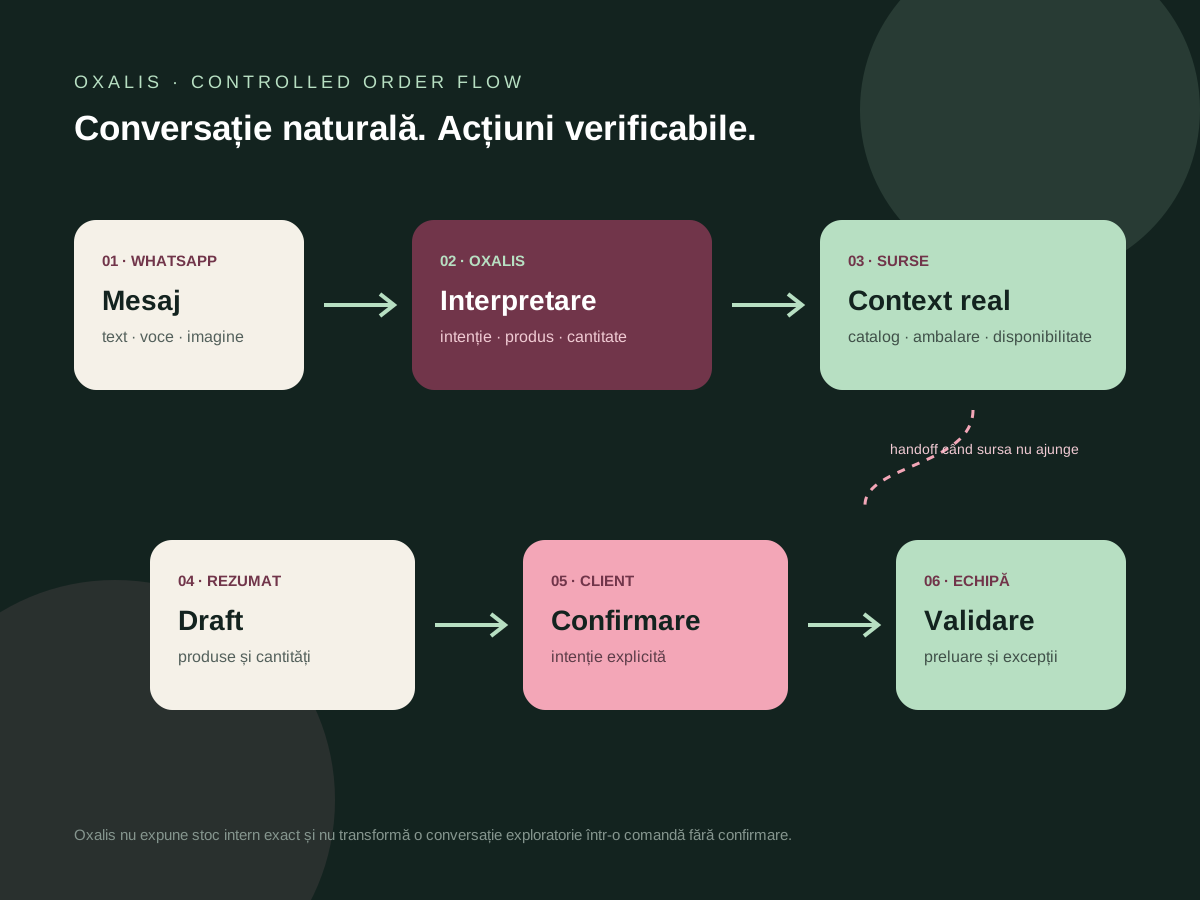
From conversation to operation
Not a chatbot that improvises. A digital colleague with clear boundaries.
In B2B distribution, a WhatsApp conversation is rarely a simple question and answer. A customer may send an incomplete flower name, a photograph, a colour, a quantity or a quick voice message. Behind a useful answer sit a catalogue, packaging rules, availability, commercial context and a team that must be able to continue the discussion.
Oxalis was built for this context at Flowers Market Holland. It does not replace the webshop or the team. It reduces the distance between the customer's natural language and the structured information required by the operation.
The agent belongs to the ecosystem described in the Flowers Market digitalisation case study. This page examines Oxalis separately: the product problem, its public architecture and the rules that keep it useful and controllable.
The product problem
Customers want a simple conversation. The business needs structured data.
Customer language
Popular names, abbreviations, typos, colours, photographs and voice notes must be understood before a product is selected.
Catalogue reality
Products have families, variants and packaging. An approximate match must never be presented as certainty.
Volatile availability
The customer receives useful qualitative guidance, not exact internal inventory or an unsupported promise.
Consequential action
A draft can be built in conversation, but sending an order request requires the customer's explicit confirmation.
Commercial exceptions
Final price, substitutions, ambiguity and questions without a safe source must reach the team.
Human continuity
An operator receives enough context to continue naturally without asking the customer to repeat everything.
How it works
A controlled path from message to order draft.
- 01
Receive the customer's chosen format
Text, voice or images enter the same conversation. Oxalis requests clarification when the product, colour, quantity or packaging cannot be inferred safely.
- 02
Interpret the intent
The agent distinguishes product discovery, availability questions, order preparation, controlled repeat orders and requests for a person.
- 03
Consult the right source
Catalogue data, operational availability and approved knowledge have different authority and update rhythms. They are not mixed arbitrarily.
- 04
Build a verifiable draft
Discussed products and quantities are gathered in a summary. Informational questions must not silently alter the draft.
- 05
Request explicit confirmation
The customer sees what will be sent and confirms the intention. Exploration is not treated as a firm request.
- 06
Hand over to the team
Flowers Market validates the request operationally. If a safe source is missing, the conversation can reach an operator earlier.
Sources of truth
An operational agent must know not only what to say, but how it knows.
Product identity, variants and rules required to build a coherent quantity.
Current data translated into qualitative guidance without exposing exact internal stock.
Context for clarifications and the controlled selection of a previous order.
Stable, customer-safe answers. A new human response does not automatically become public truth.
Multimodal conversation
Text is only one way customers explain what they need.
Voice messages
Voice can be more natural in warehouses, flower shops and on the move. It is interpreted within the same context, with clarification when names or quantities remain uncertain.
Images
A photograph can indicate a product type, colour or visual reference. It helps orientation but is not treated as infallible identification.
Packaging and quantities
In B2B, “ten” may mean stems, pieces, bunches or packages. The agent connects quantity with the selling unit and clarifies contradictions.
Availability without inventory exposure
The answer is useful enough for a decision—unavailable, low, medium or sufficient—without publishing exact inventory.
Human in the loop
A good human handoff is a product feature, not an AI failure.
Escalation happens when the customer requests it, sources do not cover the question, information conflicts or a commercial judgement is required.
Recognise the limit
The agent does not fill gaps with guesses merely to remain fluent.
Route the conversation
The appropriate team can take over with context.
Keep human control
While an operator is active, the agent does not compete with parallel answers.
Return explicitly
After resolution, the conversation can return to Oxalis in a controlled way.
Controlled learning
Good human answers can improve the product without becoming rules automatically.
Identify the gap
Separate missing knowledge from data, integration, ambiguity or freshness problems.
Propose, do not publish
A reusable answer may become a redacted, deduplicated candidate. Transient prices and stock cannot.
Human review
An administrator validates meaning, audience and validity. Conflicts cannot auto-publish.
Versions and audit
Approved knowledge evolves through controlled versions that can be traced and withdrawn.
Deliberate boundaries
What Oxalis was designed not to do.
- No exact internal stock exposure. Customers receive qualitative guidance.
- No indicative price presented as final. Commercial confirmation belongs to the team.
- No order without confirmation. Draft and action remain separate states.
- No forced answer. A handoff is better than invented confidence.
- No automatic publication of operator replies. Learning requires filtering and approval.
- No hidden AI identity. Customers should know whether Oxalis or a person is replying.
Transferable lessons
What other B2B companies can learn from Oxalis.
Start with real conversations
Map recurring questions, vocabulary, exceptions and the systems consulted by the team.
Define sources before prompts
Catalogue, ERP, CRM and approved procedures have different authority and freshness.
Separate information from action
Answering, changing a draft and sending an order have different risk levels.
Design handoff from day one
Ownership, context and the agent's return should not be improvised after launch.
Measure usefulness
Track grounded coverage, successful clarifications, handoffs, errors and confirmed drafts.
Launch gradually
Use scenarios, limited pilots, monitoring and a quick return to the human flow.
Read the generic guide to a WhatsApp AI agent connected to ERP, the complete Flowers Market case study and our software development services for SMEs.
Frequently asked questions
What Oxalis is—and is not.
Is Oxalis a WhatsApp chatbot?
It is a conversational agent connected to Flowers Market processes and operational sources, with confirmations and human handoff.
Can it understand voice and images?
Yes. Text, voice and images are interpreted in one conversation, with clarification when confidence is insufficient.
Does it show exact stock?
No. Availability is communicated qualitatively and final operational confirmation remains with Flowers Market.
Does it send an order automatically?
Not from an exploratory conversation. It prepares a summary and requests explicit confirmation.
What happens when it does not know?
It asks for clarification or hands the conversation to an operator rather than inventing an answer.
Does it learn automatically?
New reusable answers remain redacted review candidates until a person approves them.
Does it replace the webshop or sales team?
No. It is a complementary channel that advances conversations and routes exceptions.
Build and validation
A product created where technology meets operations.
AYSA and Web-Developmentproduct direction, design, development and integration
Flowers Marketprocesses, operational validation and use
Marius Dosinescufounder and direction coordinator
See the customer-facing Oxalis page, the AYSA case study and Web-Development.ro.