
Why I would not move my SEO budget to AI Search without proven results
My perspective on AI Search investment: what traffic and conversion data show, why SEO remains the foundation and what I would fund for results now.
Huge sums are being invested in artificial intelligence, with search among the major strategic priorities. For an entrepreneur who needs to pay wages, turn over inventory and generate sales this month, industry excitement cannot replace results. I would keep investing in SEO fundamentals and require every AI Search experiment to demonstrate its business contribution before increasing its budget.
I write this from the position of an entrepreneur who is building a product in this very area, AYSA.ai. I am interested in the development of AI, I use these technologies and I believe they will change the way people discover companies and products. That's exactly why I want to keep the discussion related to what a business can actually use. If I sell technology optimism without explaining the commercial limits, I'm not helping anyone make a better decision.
My position has two parts. The first is that the available data does not justify abandoning the channels that are already producing customers in favor of a blanket promise of AI Search. The second is that an important part of preparing for this change builds on SEO work already known: technical access, useful pages, correct information, relevance and credibility. There are new peculiarities, but they must be dealt with in proportion to the opportunity and the results of each company.
I cannot demonstrate that global investment in AI is, on the whole, unjustified. For that I would need to know the full return on infrastructure, future revenues and how costs are split between products. But I can say what I would not do with a company's money: I would not turn the strategic bet of a technological giant into the obligation of an SME to immediately buy a new marketing package.
Billions in infrastructure and a business budget have different goals
Investment size is real. In its Q3 2026 financial conference call, Alphabet reported capital expenditures of $51.4 billion in the quarter and maintained a range of $195–205 billion for the full year. The company says most of the quarterly spending supports the technical infrastructure for AI. These are group infrastructure values, not a stated budget exclusively for AI Search. Alphabet source .
That distinction matters. The same infrastructure can support cloud services, models, enterprise products, advertising and consumer experiences. Dividing this amount by the visits sent by a chatbot would not establish the real cost of acquiring a customer. Nor does the size of that investment mean every retailer should shift its marketing budget towards that technology.
An infrastructure provider can work with a different payback horizon, monetize several products and pursue strategic advantages that do not appear on an online store’s balance sheet. The store faces different constraints: the cost of an order, the margin remaining after returns and how long it can fund an activity before that activity contributes to the business.
This is where my reservations begin. When I hear that hundreds of billions are being invested and that we therefore need to invest too, the crucial step is missing: how does that change create demand our company can actually serve? Enthusiasm may explain why the market is worth watching. Spending needs a justification closer to the customer.
AI usage is growing but a user is neither a search nor a customer
OpenAI announced in October 2026 that ChatGPT reaches 1.2 billion people weekly. Google announced that the Gemini app has reached one billion users, shown in the financial material as monthly active audience. They are important benchmarks about the scale of adoption, but they use different periods and products. I wouldn't put them on the same axis to calculate who took over commercial search. OpenAI ; Google .
A person can use an assistant for programming, writing, learning, analyzing a document, or organizing an activity. Sometimes they look for a supplier. Other times there is no commercial intent at all. The number of users doesn't tell me how many of them need my product, in my country, at a price I can support.
The difference in metrics is also seen in Graphite's analysis: for September 2026, the study that includes web and in-app sessions gives ChatGPT 81.2% in its universe of six products. It is not the same basis as the web visits in the Similarweb graph. I wouldn't combine the percentages and simply pick the figure that better supports a presentation. Graphite Methodology .
Moreover, the same person can use Google, ChatGPT and Claude in the same day. There is no mandatory migration from one camp to another. A human can ask for an explanation in ChatGPT, check the company in Google and buy after an email. For business, the entire route is relevant, and the last click only explains part of it.
I therefore start any discussion of opportunity by defining the metric. Are we talking about people, visits, sessions, questions that trigger web access or visits sent to stores? These are different things. If a presentation changes definitions from one slide to another, its budget conclusion can become impressive without becoming useful.
Shares among assistants describe the attention paid to
productsIn the Similarweb web visit series for September 2026, retrieved by Visual Capitalist, ChatGPT appears at 56.4%, Gemini at 25%, Claude at 9.6%, and Perplexity at 0.9%. This metric excludes the use of native apps and APIs. I use it to understand the distribution of visits between assistant websites, not as a measure of all searches or orders generated. Visual Capitalist .
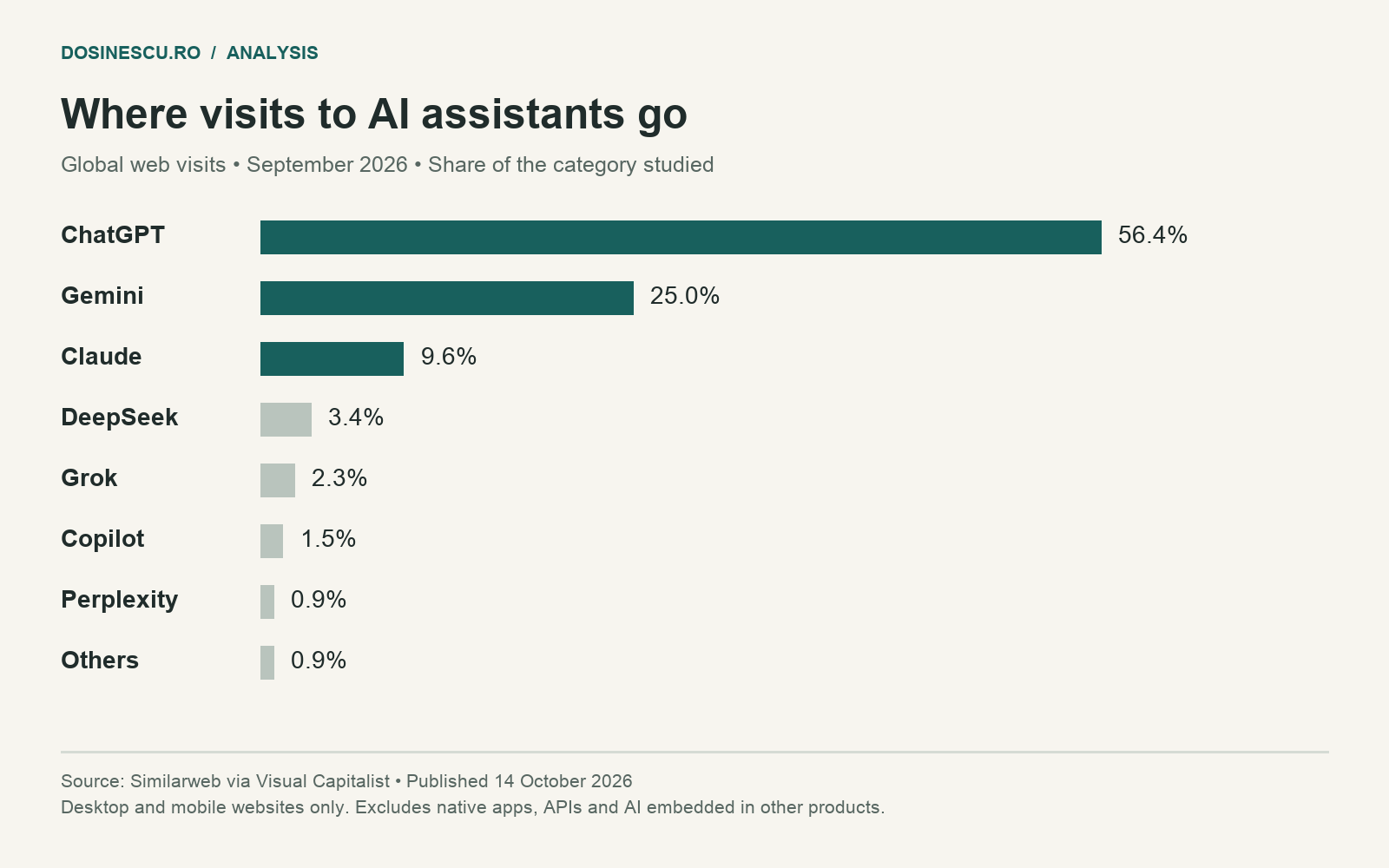
Claude can attract attention through professional uses without that growth translating proportionally into traffic for retailers. Perplexity may have a smaller audience that is relevant to particular subjects. For a specialized company, a well-matched audience can matter more than the overall ranking. That is a reason to test within its own category rather than dismiss a product based on one ranking.
Time comparison requires the same discipline. In the comparison below, changes are expressed in percentage points of web visits. Loss of relative share does not prove that a product has lost users in absolute terms, nor that people have stopped using it for shopping. The market can grow while its distribution changes.
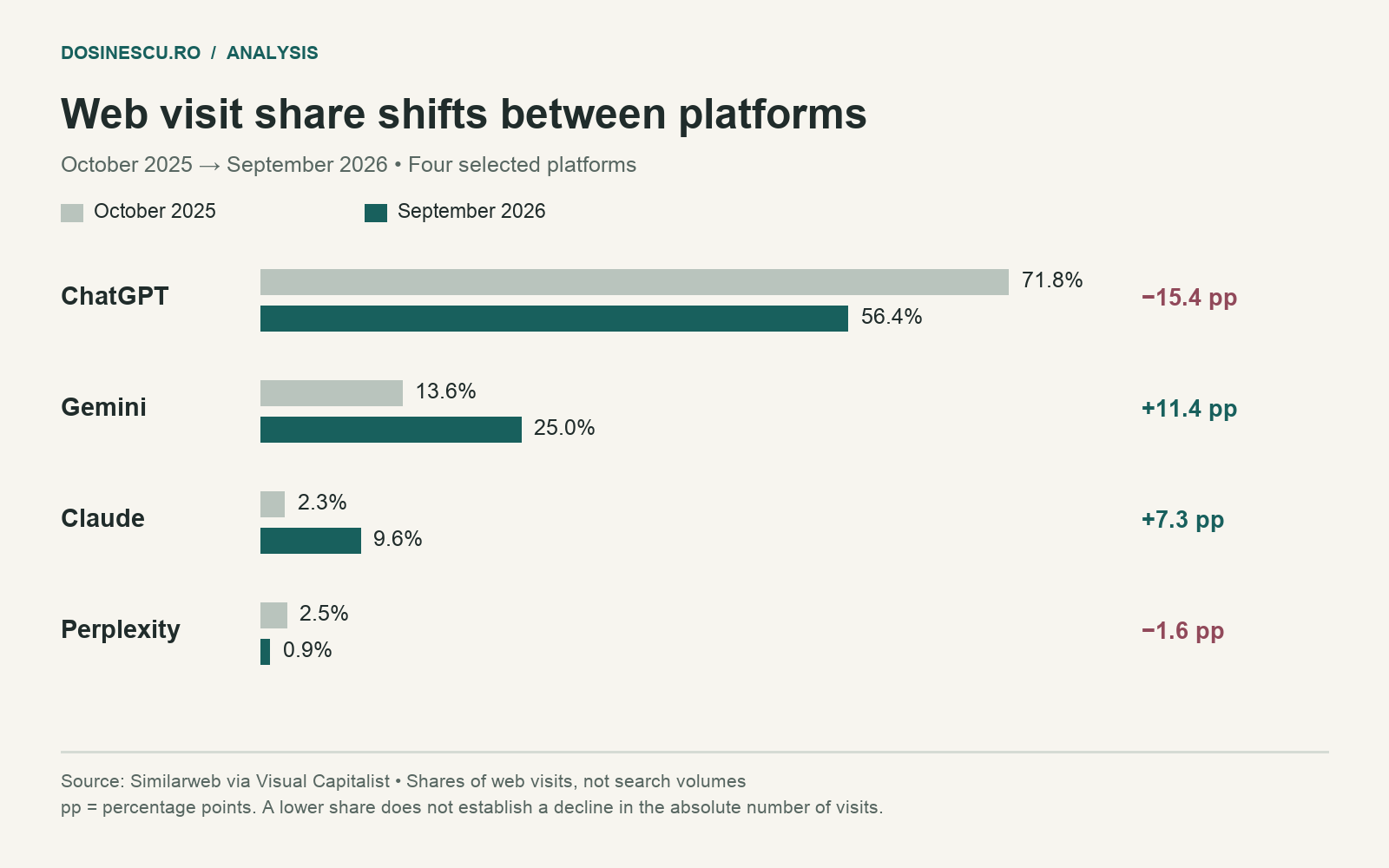
When budgeting, the ranking tells me where to look. The decision comes after I check if my audience is using those products for relevant questions and if there is an observable business contribution. Otherwise, I risk optimizing for tool notoriety instead of optimizing for customer need.
Google stays relevant and transforms its own product
Statcounter reports for October 2026 a Google share of 91.05% in its global search engine measurement. It is an indicator of usage seen by traffic on its network, not a census of all questions people ask about all digital products. It doesn't prove that AI assistants are insignificant. It shows that Google remains very important in the universe that this series measures. Statcounter Global Stats .
At the same time, Google is integrating AI into Search. In the October communication, the company describes the convergence of AI Overviews, AI Mode and traditional search. So the simple opposition between Google and AI hides even part of the transformation: a customer who continues to use Google may receive a much more conversational experience. This evolution must be included in the plan of a company that is based on search.
I wouldn't consider AI preparation to start with reducing your focus on Google. I would look at what pages are being found, how engagement with the results is changing, and the difference between visibility and visits. The same website may simultaneously need a better technical base and a more careful interpretation of the new display surfaces.
The ratio of ChatGPT to Google searches is not a share of sales
In November 2026, Search Engine Journal reported the statement by Adam Fry, head of ChatGPT's consumer product, that the queries that send ChatGPT to search the web would represent about one-fifth of Google's query volume. The article states that the Google base, period and regions of the comparison were not published. I treat the figure as a company statement, not an audited market share. SEJ reporting .
Even if we accept the comparison as an indication of scale, it does not follow that a fifth of a business's customers come through ChatGPT. A question that triggers a search can produce a complete answer without visiting any store. It can use multiple sources and help a decision that ends later in another channel.
The supplied research also contains a daily extrapolation based on an annual Google estimate and this reported ratio. I do not use it as a synchronized statistic for November 2026. Combining a historical average, a reported company statement and a Perplexity volume from another period would create false precision. Comparable information matters more to me than a dramatic chart.
Traffic reaching the site is still a small part in some studies
SE Ranking analyzed aggregate data from 101,574 websites in 250 countries and territories, with tracking between January 2025 and April 2026 and a historical benchmark for 2024. In this sample, AI referrals represent 0.32% of total traffic for the 2026 analyzed period, compared to 0.24% in 2025 and 0.02% in the benchmark 2024. The increase is 16 times, from a small base. SE Ranking study and methodology .
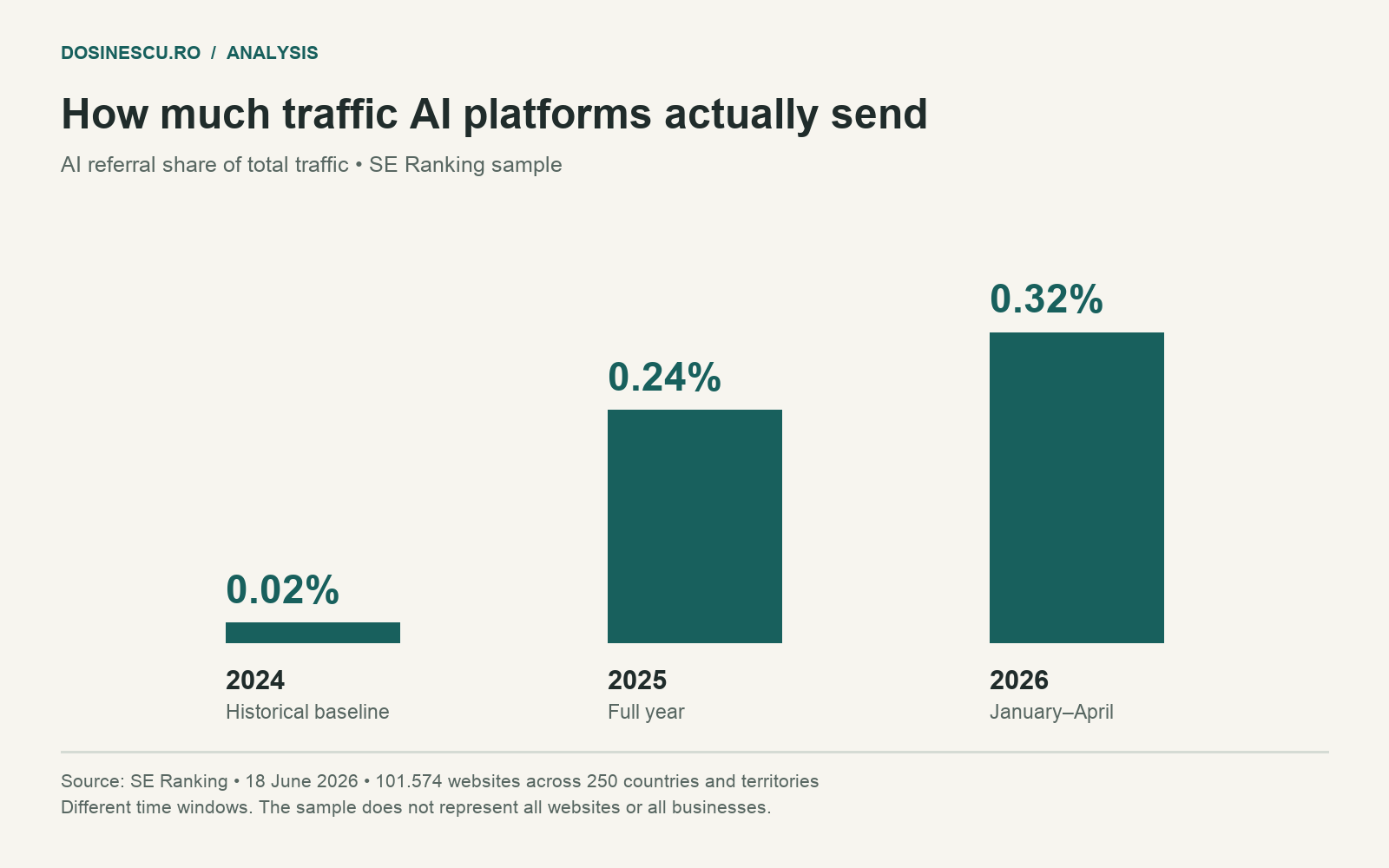
Correct reporting preserves both observations. The growth shows that the channel is worth watching. The small weight tells me that I need to carefully check how much it can contribute to the immediate goals. None of them alone give me the answer about the profitability of an intervention.
A strictly arithmetic exercise helps: 0.32% of 100,000 visits means 320 visits. I'm not saying that a site with this traffic will get exactly 320 from AI. I use the percentage only to see the order of magnitude. A team may spend a lot of time on a visibility report and find that, for now, the measurable opportunity is less than a simple checkout issue.
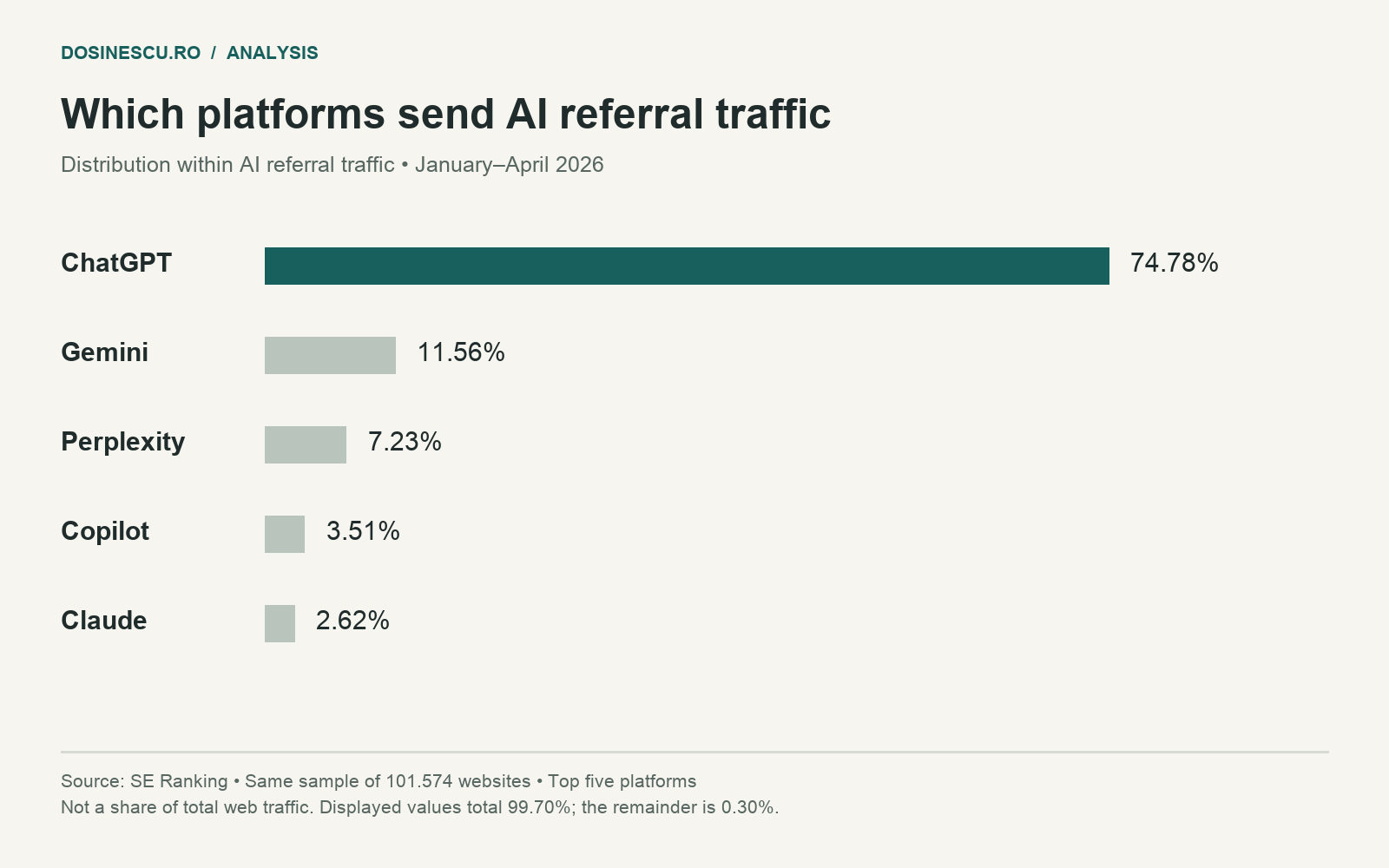
The study also shows that the distribution of referrals is different from the distribution of visits to assistants. The following graph illustrates this. I would not automatically transfer the ranking from one chart to another, nor would I treat a global sample as a forecast for Romania.
Few visits can be of great value and this must be recognized
Some evidence requires a more nuanced assessment. In its report published on 29 October 2026, Adobe says that September AI traffic to US retail had a 90% higher conversion rate and 83% higher revenue per visit than non-AI traffic. The analysis covers more than one trillion visits to US retail sites, 100 million products and 18 categories. Adobe Report
I wouldn't hide these results to make a more convenient conclusion. They show that AI can bring valuable visitors. At the same time, the comparison is with aggregated non-AI traffic, not exclusive to organic Google, and looks at US retail. It does not prove that a specific optimization service produced the increase, nor that the same performance is repeated in a Romanian SME.
Conversion rate and volume must be read together. In a hypothetical scenario, 100 visits with a 4% conversion result in four orders. Ten thousand visits with a 2% conversion yield two hundred. The first channel can be very good and still not enough for the sales target. Conversely, if the four orders have high margin and cost little to obtain, it would be wrong to ignore it.
Here is the position I can take: the potential is there, and the results differ. It is this variation that calls for a well-defined commercial test. A favorable statistic about a channel does not tell me how much it is worth to pay for an intervention in that channel.
An AI citation can influence a customer without a visible referral visit
There is also a measurement limitation. Someone may see a company named in an AI answer, then search for the brand on Google or open its website directly. Referral reporting does not capture all that influence. The absence of correctly tagged visits is not proof that there was no impact.
Graphite discusses this issue in its November 2026 analysis and shows a case study where referral attribution captured only a portion of AI-related conversions. The authors state that they do not have enough data to generalize the case to the entire market. To me, that clarification is essential: a useful case for formulating a hypothesis does not become a universal multiplier for reporting results. Graphite .
I would combine data from analytics with information from CRM and a simple question to the customer about how they discovered the company. I would also track brand searches, not saying that every increase comes from AI. Advertising, press, referrals and seasonality can change the same values.
Attribution uncertainty calls for better measurement. It cannot justify treating every invisible outcome as success. If we do not know, we should say so and identify what observation would help us decide.
More answers can mean fewer clicks
Pew Research Center analyzed the search behavior of US adults in March 2025. On AI summary pages, clicking on a traditional result occurred in 8% of visits, compared to 15% on non-summary pages; clicks on summary sources occurred in about 1% of summary visits. It is an observational study, within a defined period and population, not an experiment that fully isolates causality. Pew Research Center .
This is why I'm not satisfied with a report that says the brand appears more often. Appearance may have value, but what kind of value must be explained. For a publisher who lives on visits, a citation without a click may not compensate for the loss of traffic. For a B2B supplier, a recommendation in a comparison can contribute to a further business discussion.
The change forces me to demand more from measurement and content. I want to know what intents brought visitors, what pages are affected and what actions the user can still take. I wouldn't apply the same conclusion to an explainer article, a product category, and a contact page.
Yes SEO fundamentals remain at the core but the statement has limits
For Google's AI features, the answer is explicit in the company's documentation. SEO fundamentals remain relevant, and to appear as a source in AI Overviews or AI Mode a page must be indexed and eligible to display a snippet in Search. Google does not require additional special technical optimization for these features and does not guarantee inclusion. Google Search Central .
For the other products, I wouldn't turn this explanation into a promise that they all use the same criteria. An assistant can combine web searches, partner sources, model knowledge, and user input. Ranking in Google does not guarantee citation in ChatGPT, and a mention in Claude does not prove that the page is well positioned in Search.
However, basic work has a common utility. The company must be able to be identified correctly, the information must be accessible, the offer must be clearly described and the important claims have support. A site that hides its services in images, has conflicting information and blocks technical access does not solve its problem by adding a GEO tag to the contract.
AEO and GEO can be useful names for real-world activities: checking answers, tracking citations, and adapting to how people phrase questions. Their value comes when they describe verifiable work. If the commercial offer doesn't explain what's changing and how it's measured, the new name doesn't help me decide.
Technical access must be configured for each purpose
A concrete example of particularity is crawler access. OpenAI differentiates OAI-SearchBot, used for search, from GPTBot, associated with content that can be used for training. The settings are independent. An owner can allow access for search and deny use for training. Treating any AI bot as the same category can lead to a technical decision opposed to the commercial objective. OpenAI Documentation .
I would also check CDN protections, security rules and actual page responses. The fact that a rule looks correct in a file does not prove that the information can be accessed. At the same time, opening access does not guarantee selection in an answer. It is a condition of availability, not an order sent to the platform to recommend the brand.
On Google's side, the current documentation says that files like llms.txt are not used for visibility or ranking in Search. I wouldn't sell them as a solution for AI Overviews. There may be other systems that use other conventions, but each recommendation must be related to the product and mechanism for which there is evidence. Google Guide to Generative Search .
To me, this is a good example of proportional investment: you verify access, fix the real problem, and test the result. I avoid turning a limited technical task into a large commercial project just because it includes the term AI.
Channel and business maturity matters for results now
If a company needs orders this week, I wouldn't suggest an exploratory AI visibility project as a primary cash-flow solution. But it must be said equally clearly that even SEO started today does not guarantee immediate orders. Indexing, competition, reputation and the buying cycle can take time. I don't want to replace one exaggerated promise with another.
I would look at existing assets first. Is there demand that the company can serve? Are there pages that are already getting relevant traffic? Is the form working? Can an order be completed over the phone? Are there customers who have bought and can they come back? Is there a paid channel with proven performance that can be used within margin?
These questions do not provide a universal recipe. A business with a good product and functional measurement has other options than one that doesn't know where the leads are coming from. A mature site can derive value from improving existing pages. A new site needs to build relevance and credibility. Priorities are set according to the actual situation.
In this workflow, AI can be very useful as a tool for analysis, content preparation, or controlled execution. The usefulness of AI in the marketing process, however, is a different question than the volume of customers brought in by AI Search. I can benefit from the first even if the second is still reduced in my business.
A good conversion rate does not prove the profitability of a service
When evaluating a proposal, I want to see the relationship between cost, activities and business contribution. An agency may show that AI visitors convert well, but that does not establish that its fee is justified. I need to know whether the work brings additional visits or customers, whether its effect can reasonably be separated from other activities and whether the margin covers the cost.
Consider an explicitly hypothetical scenario. A company spends €2,000 on a test and attributes 20 orders to that channel. The acquisition cost is €100 per order. If contribution margin is €30 per order, those orders contribute €600 before the test cost. Order value and a visibility chart do not close that gap.
The example may look different in a business with recurring, higher margins or B2B sales. There, revenue and contribution should be tracked over the life of the relationship, with explicit assumptions about retention. I wouldn't use the theoretical value of a multi-year customer to hide poor initial economics.
There is also the opportunity cost. If the same team delays fixing important pages to produce reports without a clear use, the real cost of the experiment is higher than the invoice. People's time must be factored into the comparison.
How would I separate the effect of the intervention from the general market development
A before and after report doesn't automatically show me the effect of purchased work. If AI platforms are used by more people, a website can receive more visits from that channel even without intervention. If the business is running a brand campaign at the same time, mentions may increase for other reasons. I would ask that reporting include these possible explanations, not attribute all progress to the last project started.
Where the situation allows, I would compare sufficiently similar pages or categories, only some of which receive the intervention. I would keep the period, applied changes and relevant trade events. In a small business, the data may be too sparse for a strong statistical conclusion. That doesn't forbid the decision, but it does change the way I present it: I have a hint and a hypothesis to go on, not a definitive demonstration.
I would also check what kind of mention the company got. The brand may appear in a long list, warning, or response that misrepresents the service. All can be counted as presence, although they have very different commercial meanings. For me it matters if the user gets a correct picture of the offer and can take a useful step towards the purchase.
This also introduces responsibility for information reaching the market. An old price, the wrong delivery area, or a promise the company can't keep can result in inappropriate requests. I would track down these errors and correct the sources I control. Visibility is only valuable to the extent that it can support a healthy business relationship, and an increase in impressions does not make up for a poorly presented offer.
What I would ask before approving an AI Search experiment
I would start with a limited commercial objective. For example, I want to know if clearer information about a specialized service can improve discovery and contribute to suitable leads. I would choose a set of relevant questions, a market and a language. I would include questions without the brand name, so as not to confuse the recognition of an already indicated company with its organic discovery.
I would save the initial situation and repeat the measurements under documented conditions. A single favorable response is an observation, not a market share. The date, the product, the wording of the question and the context of the conversation matter. Customization and variation in responses call for caution when comparing two captures.
Interventions should be precise: correct information about the service, clarify the page, verified technical access, updated business data or publish a useful proof. I would avoid mass production of nearly identical pages just to cover prompt variations. The cost and risk of site degradation may outweigh the intended benefit.
At the beginning I would also set the time limit, budget and continuation condition. For some companies it can be a test of several weeks; for a longer B2B cycle, the right intermediate steps should be followed. If we don't have sales yet, we say exactly what we have observed and what remains unproven. The next budget must depend on that assessment.
What I would do in the first ninety days
In the first step I would check the measurement and problems that can block already accessible results. I would test orders and forms, reconcile important events with business data, and identify pages participating in the sale. Without this foundation, any new channel may appear good or poor due to a wrong measurement implementation.
Then I would improve the pages with a clear commercial role. I would ask for accurate descriptions, information on availability, pricing or terms where they can be published, and answers to real customer questions. I would check internal links and path to action. These interventions can help both the user and the systems trying to understand the offer.
I would place the AI experiment on a well-chosen part of this process. I wouldn't automatically apply a split like 50% Google, 30% ChatGPT and the rest other platforms. Percentages from a strategic assumption do not become a budget recommendation without information about the firm. A local clinic, an international SaaS and a seasonal trader can have very different priorities.
At the end of the period, I would compare what was implemented with what changed. I would separate visibility, visits, leads, orders and earnings. I would expand the activities for which there is a justification, correct what did not work and stop what consumes resources without relevant progress. An experiment done right can be useful even if the answer is that the investment is not yet worth increasing.
Why I am building AYSA.ai around work that reaches the website
This perspective also influences the way I see AYSA.ai. The platform must help the company understand what is worth doing and move the approved work to execution. Agent8 is the AI agent in the platform. Business context, research, action preparation, approval, and verification make sense when they bridge the gap between an observed problem and an applied improvement.
I don't want the product to depend on the idea that Google has to lose for us to be relevant. A business may need better pages, clearer information and approved SEO changes no matter where the next conversation with a customer begins. AI monitoring is useful if it shows me a problem or opportunity that I can investigate.
It would be a mistake to promise that a visibility score in AI automatically turns into income. Product work should also be judged by relevance of actions, correctness of execution and usefulness to the team. Commercially, results should be tracked in business data, with attribution limits explained.
To me, this discipline is compatible with AI investment. It allows me to use the technology for concrete things and at the same time keep a demanding evaluation of the promises about the new distribution channel.
Where would I draw the line between preparation and expensive enthusiasm
I would assess an improvement with broad value differently from a project that targets only a fragile metric. Fixing page access, updating important information or clarifying an offer can retain value even if an assistant changes how it selects sources. A project that depends on the brand appearing for ten conveniently selected prompts carries a different risk.
I want to see what remains after the contract ends. Are there better pages, more accurate data, an updating process and reliable measurement? Or only screenshots of answers that could change tomorrow? I support monitoring when it informs a decision and leads to useful work.
Responsible preparation can begin before the market becomes large for each business. The important thing is not to attribute to it a return that we have not yet demonstrated. A company with resources can fund exploration for longer. One with limited liquidity must first protect its ability to operate.
I would fund the evidence before I fund the promise
AI Search is worth a serious look. It has high usage, evolves rapidly and can influence the selection of products and suppliers. There is already valuable traffic data, and some companies have good reasons to invest more than others. But we don't have a demonstration that any business needs to move its main budget in this direction now.
For a business that needs results now, I would protect proven channels and fix obstacles already preventing conversion. I would keep AI Search experiments proportional to the resources available and the evidence observed. I would expand them when there is evidence of a contribution to business objectives, not merely more discussion of the channel.
Basically, yes, an important part of the work remains SEO. For Google, this is directly confirmed by the documentation. For the wider ecosystem, the foundation is complemented by specific access, verifiable information and measurement of new routes. This continuity gives me a good reason to invest in the quality of the website, without buying every new promise of the market.
The billions spent on platforms can build the infrastructure of the future. I have to decide what creates value for the business today. Until a new channel proves its role in that business, I test it with discipline and continue to fund work for which I can explain the outcome.
Sources and Methodology
Data consulted and verified on November 23, 2026. Original Dosinescu.ro graphics, redrawn based on the cited data. The percentages describe different indicators and should not be combined: visits to assistant sites, traffic sent to sites and business results. The profitability examples in the article are hypothetical.
1. Alphabet — Financial Results and Conference Call for the Third Quarter 2026 .
2. OpenAI — Advertising and Measurement in ChatGPT October 2026 .
3. Google — Alphabet Results for Q3 2026 .
4. Graphite — The State of GenAI, November 2026 .
5. Visual Capitalist — The Most Used AI Chatbots in 2026; data Similarweb .
6. Statcounter — Search Engine Shares, October 2026 .
7. Search Engine Journal — OpenAI Statement on Search Volumes November 3, 2026 .
8. SE Ranking — AI Traffic Study, June 18, 2026 .
9. Adobe — AI Traffic in US Online Commerce October 29, 2026 .
10. Pew Research Center — Clicking Behavior in the Presence of AI summaries July 21, 2025 .
11. Google Search Central — AI Features and Your Website .
12. OpenAI — Bots Documentation .
13. Google Search Central — Guide to Generative Search Optimization .